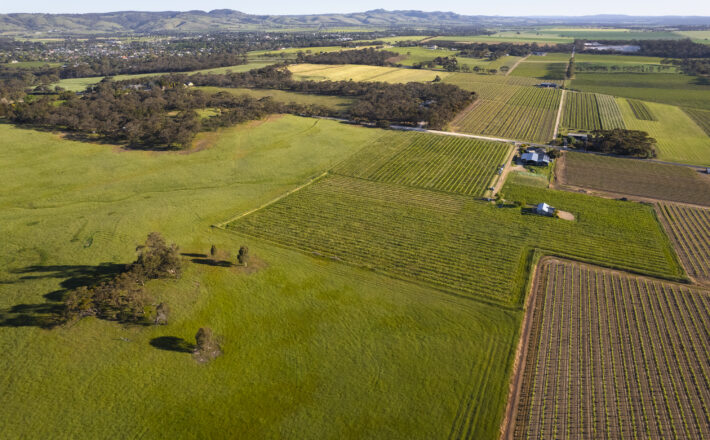
The McElroy family have been farming in Padthaway, South Australia, since the 1930s. The family has a strong background in innovation and looking after the land where they live.
Casey Lodewyk is the third generation of the family to manage the land and she is passionate about improving the value of the land for future generations. Casey has continued the drive to innovate and nurture the land by planting biodiversity areas, implementing plant-based irrigation scheduling and hosting a solar farm.
The challenge:
What to do with an area of low-value land?
Prior to planting the first grapevines on their property, the McElroy family grew a range of small seed crops and developed a strong understanding of the soils and available water of the region. In 1998, the family used their knowledge of the land to identify the best suited patch to plant the first grapevines. The family continued to expand the vineyard for several years, planting areas which were unsuitable for growing high-quality seed crops. In 2017, the family identified an area of land which was unsuitable for both seed and grape production and was no longer economically viable. A range of alternative land uses were explored; however, none were ideal or would generate an income.

The Solution:
Converting unproductive land to harvesting solar energy
The following year, a solar energy company saw the potential of the land, which happened to be next to an electricity sub-station, and the McElroy family was asked whether they would consider installing a solar farm under a land lease arrangement. After entering into a contract with Red Mud Green Energy, an initial ‘construction’ payment was made and an annual lease fee agreed for the land over a thirty-year term.
There are provisions for an additional 2 x 5-year lease extensions and at the end of the

term, the energy company is required to return the ground to its original state, including the removal of all signs, infrastructure and fences. As part of the lease arrangement, the McElroy family are required to maintain the land within the solar farm area. There is currently good pasture in the area which is maintained by mowing but they are investigating grazing sheep within the area to reduce energy use.
The family is also required to plant a tree line around the solar farm which, if they do introduce sheep, will provide additional shelter.
Nurturing the land by planting biodiversity areas, implementing
plant-based irrigation scheduling and hosting a solar farm.
Chris Dent, Managing Director of Gorton Drive Estates in Swan Hill, Victoria and Sustainable Winegrowing Australia Board Member says, “For growers, sustainability has to work in the vineyard as well as on paper. Sustainable Winegrowing Australia gives us a practical framework to keep improving, demonstrate what we’re doing and respond to what customers and communities increasingly expect.”
As the definitive, nationally supported sustainability program, Sustainable Winegrowing Australia has seen remarkable adoption. Data from the financial year ending 30 June 2026 paints a picture of an industry united in purpose:
- A growing community: 1,995 members are now enrolled nationwide, with 80% having put in the rigorous work to achieve full certification.
- A national footprint: The movement spans the continent, with members representing 58 of 65 Australian wine regions and covering 70% of Australia’s winegrape vineyard area.
- Scale and impact: The sheer volume of this commitment is evident in the cellar with 96% of the 2025 winegrape crush occurring within Sustainable Winegrowing Australia member wineries.
- The final pour: As a result, the equivalent of over 357 million bottles of wine now qualify to display the Sustainable Winegrowing Australia trust mark proudly.
For the modern consumer, this trust mark is much more than a label on a bottle. It is a story of care, a guarantee of responsible practices, and a symbol that is increasingly shaping how people experience Australian wine. The program is modelled on global best practices and aligned to the United Nations Sustainable Development Goals, with progress towards these monitored annually.
With unwavering national support, Sustainable Winegrowing Australia is ensuring that the story of Australian wine remains one of quality, integrity, and a profound respect for the earth, for generations to come.